NEW PEGYLATION
Next-Generation PEGylation for Immune-Smart Therapeutics
Redefining the PEG–Biomolecule Interface
PEGylation has long been a cornerstone technology for enhancing the pharmacokinetics and stability of biologics, nanoparticles, and diagnostic agents. However, conventional PEG systems suffer from immune recognition at the PEG–substrate junction.
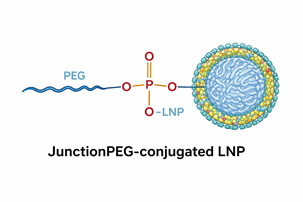
JunctionPEG introduces a new paradigm by engineering the junction itself using charged or zwitterionic groups.
The Innovation: Functionalized Junction Architecture
JunctionPEG embeds electrostatically active moieties at the PEG–substrate interface, enabling control over local physicochemical properties without disrupting PEG backbone performance.
Mechanism of Advantage
- Reduced anti-PEG antibody binding
- Attenuated complement activation
- Enhanced interfacial hydration
- Improved structural stability
Performance Benefits
- Lower immunogenicity
- Reduced complement-mediated toxicity
- Improved circulation time
- Consistent efficacy upon repeated dosing
Applications
- Biologics and enzymes
- Nanomedicine and LNPs
- Diagnostics and biosensors
- Advanced biomaterials
Why JunctionPEG?
Compared to conventional PEG, JunctionPEG provides active junction engineering, reduced immune recognition, and improved repeat dosing performance.
Engineering the interface. Transforming performance.
[Examples of JunctionPEG-conjugated Protein or LNP]
mPEG–O–PO₃–CH₂CH₂–CO–NHS + Protein → mPEG–O–PO₃–CH₂CH₂–CONH–Protein
mPEG–O–PO₃–CH₂CH₂–CO–NHS + LNP → mPEG–O–PO₃–CH₂CH₂–CONH–LNP